You have 0 items in your cart



STOP #5 – GARDEN #335
Second World War and the Liberation of the Netherlands
1939 – 1945
The roots of the Canadian Tulip Festival reside in the Liberation of the Netherlands during the Second World War, and providing refuge for members of the Dutch Royal Family, resulting in the only royal ever born in Canada.
The Canadian Tulip Legacy is devoted to commemorating over 7600 Canadian and Indigenous Canadian lives lost in the fight to liberate the Kingdom of the Netherlands from Nazi Occupation.

 Canada played a significant role in the liberation of the Netherlands during World War II, particularly during the final stages of the conflict in 1944 and 1945.
The role of Indigenous Canadians in the Second World War was significant, though often overlooked in historical narratives. Despite facing discrimination and systemic barriers in their own country, many Indigenous Peoples volunteered to serve in the Canadian Armed Forces during World War II.
Approximately 3,000 First Nations members served in the Canadian military during the war, alongside Métis and Inuit individuals. They fought in various capacities, including as infantry soldiers, snipers, scouts, and in other support roles. Indigenous servicemen and women served with distinction and bravery in key battles and campaigns, including the Dieppe Raid, the Italian Campaign, and the D-Day landings in Normandy. They faced the same dangers and challenges as their non-Indigenous counterparts and made significant sacrifices for their country.
It’s important to note that Indigenous veterans often faced discrimination and challenges when they returned home from the war. Despite their contributions and sacrifices, they did not always receive the same recognition or benefits as non-Indigenous veterans. However, their service played a crucial role in shaping the history of Canada and contributed to the ongoing struggle for Indigenous rights and recognition in the country.
Following Germany’s invasion of Poland in 1939, Britain swiftly declared war. In tandem, Canada also entered the conflict, initiating an extensive campaign to recruit young individuals and bolster its navy, army, and air force. In the subsequent spring, Germany further expanded its aggression by invading and occupying the Netherlands and Belgium while launching an assault on France. Faced with the escalating threat, the Dutch royal family sought refuge in Britain under the leadership of Queen Wilhelmina, who endeavored to support her country in its time of crisis. However, Britain itself faced the looming specter of invasion and endured nightly bombardments by enemy aircraft. To ensure the safety of her daughter and heir to the throne, Princess Juliana, along with her two young children, sought refuge in Canada, where they settled in Ottawa. It was in Ottawa Civic Hospital that Princess Margriet, Juliana’s daughter, was born in a room temporarily designated as part of the Netherlands to safeguard the child’s succession rights. Meanwhile, Canada’s navy played a vital role in escorting ships carrying essential supplies of food, personnel, and equipment to Britain, reinforcing its support for the Allied cause.

Our air force embarked on constructing training airfields to facilitate the instruction of Commonwealth air personnel in flying skills. Simultaneously, the army dispatched troops to Britain for further training, anticipating the opportune moment to launch an invasion of continental Europe. Despite the prolonged wait, the Allies finally found themselves prepared in June 1944. On D-Day, June 6, 1944, a monumental invasion unfolded unexpectedly on the expansive beaches of Normandy, France. By autumn, France had been liberated, yet the conflict persisted. Canadian forces were entrusted with the mission of freeing coastal towns and cities in France and Belgium, while the British initiated Operation Market Garden to pave the way into the Rhineland. Their efforts yielded success in liberating the crucial Belgian port of Antwerp. However, the ships accessing Antwerp navigated through the estuary on the Scheldt River in the Netherlands.
The Canadians were tasked with securing the estuary in the Battle of the Scheldt. Despite enduring weeks of arduous combat in freezing and often wet conditions, the Canadians managed to liberate the entrance. Subsequently, they were directed to advance into the Netherlands, where conditions were dire. Widespread starvation prevailed as the enemy monopolized most of the food supplies. The populace resorted to consuming tulip bulbs for sustenance. Despite the challenging circumstances, fighting persisted into the spring of 1945, but Canada ultimately achieved success and formally accepted the German surrender in May. Upon the Canadians’ arrival in cities, the Dutch people greeted them with tulips, wine, and other gifts as tokens of gratitude.
The Royal Canadian Air Force (RCAF) played a pivotal role in Operation Manna, a mission aimed at delivering food to the people. Airlifts of essential supplies were meticulously coordinated. However, these flights were fraught with peril, flying at low altitudes and thus vulnerable to anti-aircraft fire and enemy fighter planes. Nevertheless, it was a life-saving endeavor, deeply appreciated by the Dutch populace. Some went as far as climbing onto their rooftops to paint messages expressing gratitude, such as “Thank you, Canada.”
 Princess Juliana expressed her gratitude by gifting thousands of tulip bulbs to Canada annually. This generous gesture sparked the inception of the Canadian Tulip Festival. Even half a century later, the Dutch people remain thankful. A statue symbolizing the jubilation of liberation, known as the Man with Two Hats, was revealed in the Dutch royal city of Apeldoorn. In 2002, commemorating the 50th anniversary of the Canadian Tulip Festival, a replica statue, crafted from the original mold, was bestowed upon Ottawa, becoming a significant landmark for each year’s festivities.
The Man with Two Hats statue was revealed during the 50th Canadian Tulip Festival in 2002 by Princess Margriet of the Netherlands. It is an identical twin of the statue situated in the Royal Dutch City of Apeldoorn, where Princess Margriet resides at Het Loo Palace. Symbolizing the strong bond of friendship between the two nations, the statue holds a special significance. Interestingly, the plaque at the base of the statue intentionally sits slightly off-center, aligning directly with the direction of Apeldoorn.
https://www.rcl005.nl/branch-info/monument-apeldoorn/
Red Pride
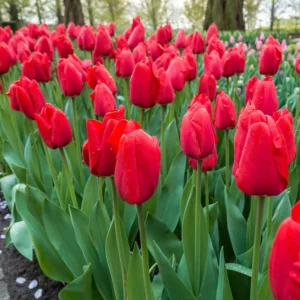
When you think tulip, you think Red Pride. The Red Pride triumph tulip holds the iconic tulip silhouette we all know. Associated with love and passion, this tulip makes the perfect flower for blossoming couples.
Vogue
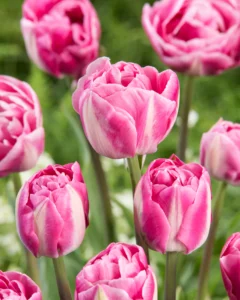
Introducing, Vogue. Vogue is what’s known as a double tulip, unlike traditional six petal tulips a double tulip blossoms into stunning multi layered petal arrangements. Curiously the Vogue is also known to lighten in colour as it ages.
Orange Pride

Energy, strength, and zest for life, this is what comes to mind when most see the Orange Pride. The Orange Pride carries a strong flower, big leaves, and a sturdy stem. This and its ability to grow up to 50 cm tall makes the Orange Pride a tulip of true strength.
Orange Queen

This tall beauty known as the Orange Queen is well regarded for its properties as a perennial tulip, meaning it can produce many more flowers over years when given attentive care.
Yellow Pride
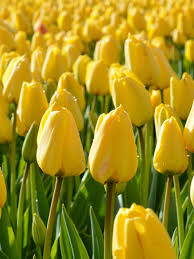
A popular triumph tulip, the Yellow Pride is known around the world for its illuminating colour. Yellow Pride are also strong perennial tulips that create outstanding numbers of flowers for years after the first planting.
Yellow Pomponette

This large petaled yellow tulip is sure to catch your eye with its impressive double bloom and bright joyful colours. The Yellow Pomponette is a true marvel to the senses in both scent and beauty.
Green Power
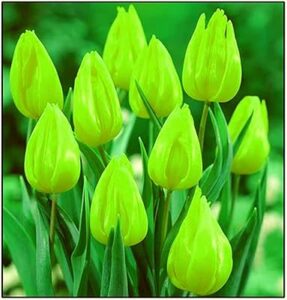
Introducing the first ever all green tulip, it’s Green Power! Green Power, like other tulips, has edible petals that can be seen being used in salads, fitting for something so leafy green!
Super Parrot
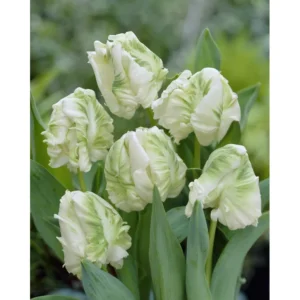
Frilly and adventurous, it’s the Super Parrot. A notable feature of Parrot tulips are their frilly leaves resembling the feathers of a parrot. The Super Parrot with its white with green highlights colouring it stands out like the white cockatoo we compare their petals to.
Muscari Big Smile
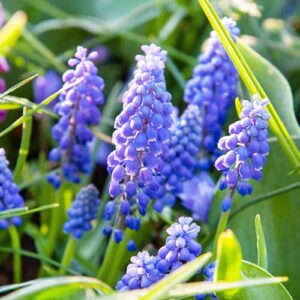
This funny shaped friend will have you marveling at its bell shaped flowers and shrunken top. Muscari produce foliage towards the end of their bloom to create a healthy environment for future blooms.
Muscari Mount Hood
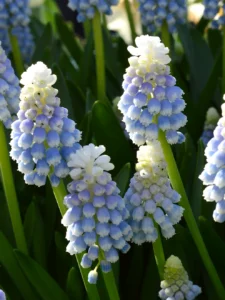
Almost an inverse of the “Big Smile”, the Muscari Mount Hood blooms large bulbous tops which thin out further down the flower.
Hyacinthus Rembrandt
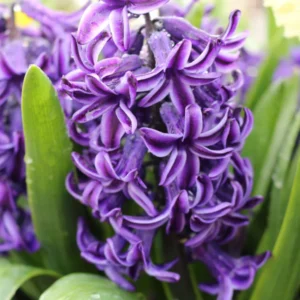
The Hyacinthus Rembrandt grows up to twelve inches in its bloom and creates nearly a sphere of spindly flowers around the plant. A colouration of white edges and a purple center is perfect for attracting pollinators as purple stands out in most pollinators vision.
Purple Pride
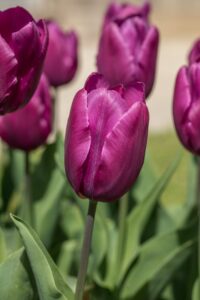
This giant tulip known as the Purple Pride is famous for its raw strength as a flower. The Purple Pride is the first ever purple petaled Darwin tulip. Darwin tulips are a type of tulip known for strong stems and large blooms. The perfect size to show off all that colour.
Secret Parrot
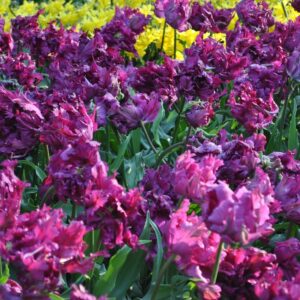
Frills, deep purples, and a gentle figure, it’s the Secret Parrot! This tulip stands out among its other frilly cousins by being a parrot-double hybrid, having both the frills of a parrot, and the impressive number of petals found on a double tulip.